What is gestalt therapy?
Gestalt therapy is a talking therapy about what is happening for you right now. It helps you notice your thoughts, feelings and actions as they happen, to understand how you relate to others.
"Gestalt" is German for a whole or a pattern. Gestalt therapists see each person as a whole, made up of mind, body and soul.
Sources: BACP: types of therapy, BACP: Gestalt therapy
Where it comes from
Fritz Perls, Laura Perls and Paul Goodman developed gestalt therapy. Its founding book came out in 1951.
It shares its name with gestalt psychology, which studies how we see patterns and wholes. The two are separate fields.
The national organisation for gestalt therapy in the UK is the UK Association for Gestalt Practitioners.
Sources: Clarkson & Mackewn 1993, Amendt-Lyon & Spagnuolo Lobb n.d., APA: Gestalt psychology, Henle 1978, UKAGP: overview
How it works
The focus is on raising your awareness of how you are, here and now.
Your therapist asks how more often than why. How are you sitting as you say that? What are you feeling now?
Your body is part of the conversation. A gestalt therapist notices what your body is doing as much as what you say.
Your therapist takes part as a real person, and may tell you how your words affect them.
- Body and feelings You notice sensations and emotions as they arise in the session.
- The exchange You and your therapist explore what happens between you.
- An experiment Your therapist may suggest drawing, objects or another way to explore your experience.
Gestalt sessions vary. Experiments support exploration; there is no single exercise that every session must include.
Sources: BACP: Gestalt therapy, Beutler et al. 1998
The empty chair
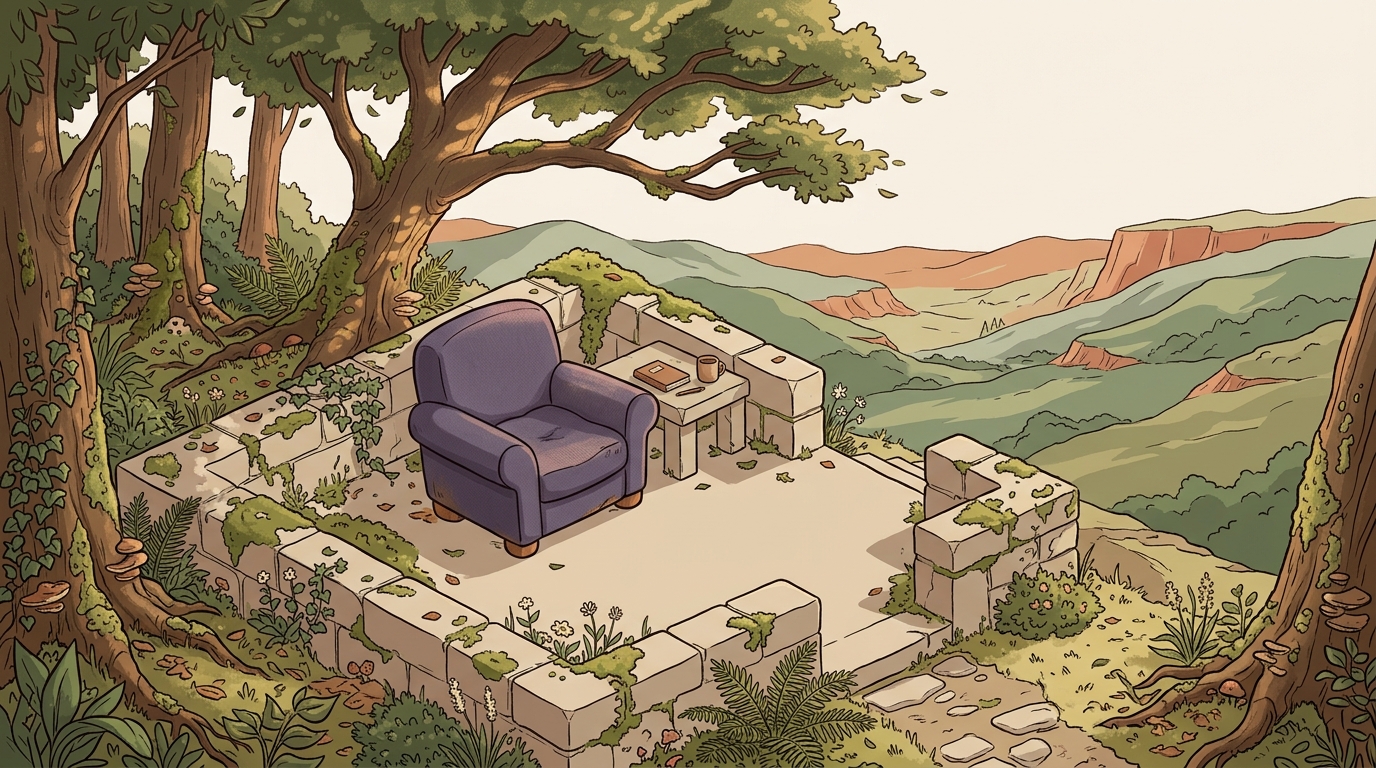
The best-known gestalt technique is the empty chair. You imagine a person in it, or a part of yourself you are in conflict with.
You tell them how you feel. Then you move to that chair and answer from their side.
Therapists use the chair for what gestalt calls unfinished business. That might be words left unsaid to a parent or someone else close to you.
- Imagine the other side A chair represents a person or a part of yourself you feel in conflict with.
- Give your side a voice You explain your feelings to the imagined listener.
- Try the other viewpoint You may move to the chair and speak from that imagined perspective.
This is one possible therapist-guided experiment. The imagined reply does not tell you what another person thinks.
Sources: BACP: Gestalt therapy, Paivio & Greenberg 1995, APA: empty-chair technique
What sessions look like
Most people see a therapist once a week, for about 50 minutes. There is no single way to run a session, because each therapist brings their own style.
Your therapist may suggest experiments, such as using objects in the room or drawing. BACP's ethical framework asks therapists to work with your informed consent, so you can say no to any of them.
Some therapists suggest something to try between sessions.
Sources: UKCP: FAQs, BACP: Gestalt therapy, BACP: ethical framework, Kaisler et al. 2023

Who it might suit
It can be a good fit if you:
- Feel cut off from your feelings or your body
- Talk about your life a lot but still feel stuck
- Carry things you did not get to say to someone
- Want a more active kind of therapy
- Are curious about how you come across to other people
It may suit you less well if you want a set programme with clear steps. Therapies such as CBT are more structured, with goals and tasks between sessions.
How it differs from other approaches
Gestalt therapy belongs to the humanistic family, with person-centred and existential therapy. It is more active than person-centred therapy, because your therapist guides the process more.
Source: Elliott et al. 2021
The evidence
A 2004 review described the evidence behind gestalt techniques as minimal. The same review said research by then put the two-chair technique ahead of other approaches for unfinished business.
In a 1995 trial, 34 people with unfinished business had either empty-chair work or a group course about it. The chair-work group improved more, and kept its gains. The trial tested one gestalt technique, not gestalt therapy as a whole.
A UK study looked at outcomes for 180 people who saw gestalt therapists. Its authors concluded the gestalt therapists appeared as effective as other therapists working in the NHS and in primary care. It had no comparison group of its own.
NICE does not name gestalt therapy in its guidance on depression or anxiety. The NHS Talking Therapies manual does not list it either.
Still deciding? Our guide to the different approaches compares the most common ones.
Sources: Wagner-Moore 2004, Paivio & Greenberg 1995, Stevens et al. 2011, NICE NG222, NICE CG113, NHS England: talking therapies manual
Thanks for your interest. We're not taking on new clients at the moment.
Looking for a gestalt therapist?
We ask what matters to you, then find professionals who fit.
- I want to be more in touch with what I feel
- There are things I did not get to say to someone
- I want a therapy that includes my body
- I want to try gestalt therapy
References
- British Association for Counselling and Psychotherapy (n.d.). Types of therapy: An A-Z of therapeutic approaches. bacp.co.uk
- British Association for Counselling and Psychotherapy (n.d.). What is Gestalt therapy?. bacp.co.uk
- Clarkson, P. & Mackewn, J. (1993). Fritz Perls. SAGE Publications. doi:10.4135/9781446280553
- Amendt-Lyon, N. & Spagnuolo Lobb, M., European Association for Gestalt Therapy (n.d.). What is Gestalt therapy. eagt.org
- American Psychological Association (2018). Gestalt psychology, APA Dictionary of Psychology. dictionary.apa.org
- Henle, M. (1978). Gestalt psychology and Gestalt therapy. Journal of the History of the Behavioral Sciences. doi:10.1002/1520-6696(197801)14:1<23::AID-JHBS2300140105>3.0.CO;2-Y
- UK Association for Gestalt Practitioners (n.d.). About UKAGP. ukagp.org.uk
- Beutler, L. E., Booker, K. & Peerson, S. (1998). Experiential treatments: Humanistic, client-centered, and gestalt approaches. Comprehensive Clinical Psychology. doi:10.1016/B0080-4270(73)00189-9
- Paivio, S. C. & Greenberg, L. S. (1995). Resolving unfinished business: Efficacy of experiential therapy using empty-chair dialogue. Journal of Consulting and Clinical Psychology. doi:10.1037/0022-006X.63.3.419
- American Psychological Association (2023). Empty-chair technique, APA Dictionary of Psychology. dictionary.apa.org
- UK Council for Psychotherapy (n.d.). Psychotherapy FAQs. psychotherapy.org.uk
- British Association for Counselling and Psychotherapy (n.d.). Ethical Framework for the Counselling Professions. bacp.co.uk
- Kaisler, R. E., Fede, M., Diltsch, U., Probst, T. & Schaffler, Y. (2023). Common mental disorders in Gestalt therapy treatment: a multiple case study comparing patients with moderate and low integrated personality structures. Frontiers in Psychology. doi:10.3389/fpsyg.2023.1304726
- Elliott, R., Watson, J. C., Timulak, L. & Sharbanee, J. (2021). Research on humanistic-experiential psychotherapies: Updated review. Bergin and Garfield's Handbook of Psychotherapy and Behavior Change. pureportal.strath.ac.uk
- Wagner-Moore, L. E. (2004). Gestalt therapy: Past, present, theory, and research. Psychotherapy: Theory, Research, Practice, Training. doi:10.1037/0033-3204.41.2.180
- Stevens, C., Stringfellow, J., Wakelin, K. & Waring, J. (2011). The UK Gestalt psychotherapy CORE research project: the findings. British Gestalt Journal. britishgestaltjournal.com
- National Institute for Health and Care Excellence (2022). Depression in adults: treatment and management (NG222). nice.org.uk
- National Institute for Health and Care Excellence (2020). Generalised anxiety disorder and panic disorder in adults: management (CG113). nice.org.uk
- NHS England (2024). NHS Talking Therapies for anxiety and depression manual, version 7. england.nhs.uk (PDF)